Showing posts with label Family Fun. Show all posts

Monday, September 5, 2016

Australia, Queensland, Gympie: Visiting Cooloola Berries is a Great Way to Enjoy a Day with the Family and Friends


It has been a while since I have written a posting to the Compassionate World Traveler Site. I do apologise for that. It is not that I have not traveled, or even had some compassionate visiting experiences in the world since my last posting in 2014. On the contrary, I have had many.

Since then I have started volunteering at the local Tourist Information Office. I have also completed a Certificate III in Tourism and every month for the last 18 months, I have visited places around my new adopted community with my fellow volunteers. Maybe it is this transformation of the personal travel experience from being the visiting traveler myself to at the same time being an advisor to the tourists visiting the local area that has been the changing factor for me expecting more of my own personal travel experiences than before. For me, even the whole concept of travel has had a profound transformation. It turns out that what I now want is to feel that the places I visit and the people I meet there truly connect with me and my compassionate nature. That helps to heighten the personal experience and I as a traveler am bound to leave with some new knowledge, a refreshed mind and a renewed conviction that the world we live in is indeed, a great place to be. So, the new attitude has taken its time to reform but now that I have found my way, it feels as a right time to blog once more.

I cannot praise highly enough of our recent experience at the Cooloola Berries Family Farm in Gympie, Queensland in Australia. What a way to spend a day with grandkids and enjoy the fresh produce of the local area and the compassionate nature of the owners Kim and Jason.
They run this farm with their whole family with the warmth and care that really makes the visitor feel at home. I felt like I was in Finland as a child, picking strawberries and running around the field like a free spirit. Even my daughter commented very similarly, saying that it really felt like it because the children were able to have such an unrestricted wide space where they were allowed to just play and pick and eat as many berries as they felt like. The adults could sit at the café tasting food and observe it all in relaxation. No need to run around herding the kids and shouting 'no, nos'. The little cabby house, the tractor and the berries were entertaining enough for a long while for our children.
Not only the simplicity of the play but at this place they make their own #tastesunshine ice-cream in the house. We went on a Saturday, which is of course a Cooloola Berries Pancake Day, ice-cream included. Of course there is lots of other food possibilities as well but we wanted to feel the freshness and experience the delight of being alive on that day. So pancakes it was:
Kim told me that the café buyes the basic ice-cream from Bulla and then they have a machine that blends the berries and other ingredients to the mix and ola, a new special natural in-house flavor is created. Of course, I and my grandson chose strawberries. My daughter chose to have chocolate and my granddaughter ate the mango and ginger ice-cream. What can be better than that? And there we were, enjoying a very memorable day, siting on some strawberry material covered chairs in the shed area while looking over the strawberry fields. It nearly made me poetic and wanting to sing some old Beatles songs about 'Strawberry Fields Forever'. The comments I heard around me were: 'Next time when we come, we will try this, instead'. It feels like we now have found that special place to come and celebrate anything and everything we used to have in our former place of residence.
Getting there was a bit tricky, though, because of the distance from the Gympie town past the adorable rural landscape. The distance turned out to be 25kms through the Tin Can Bay Road and then taking the Wolvi turn and following the little strawberry signs that guided our way to the farm. Driving there proved to be an experience itself. I found it very enjoyable and invigorating.

So, there you have it. Check it out though their WEBSITE. The strawberry season is through June to December and the blueberries are ripe in December. Enjoy and share.


Saturday, May 24, 2014

Finland, Oulu: Introducing The Doghill Kids (Koiramäen lapset) at the Museum of Northern Ostrobothnia


Mauri Kunnas must be one of the most loved illustrators and storytellers in Finland. The books on his wonderfully delightful Doghill Family have been concurring the world and the imagination of many, many children.


The books represented in the permanent exhibition at the Northern Ostrobothnia Museum in Oulu, Finland are 'The Doghill', 'On the Doghill Farm' and 'The Winter at the Doghill'.


The 1990's Doghill project was very large involving the Museum, The Artists Workshops, the Youth workshops and the Oulu Theatre. The aim was to bring history nearer to children by creating scale models of the very true to history books by Mauri Kunnas.

Through viewing the larger scale models and the tiny precise models of the everyday life equipment of the old days, children could relate to the real historical artifacts placed at the other parts of the museum.


Here for example are the looms that were used in weaving in the old days.


And here is the way the hay was harvested.

I found that while visiting the Northern Ostrobothnia Museum, the little exhibition on the Doghill Family was just so much fun.

Suddenly I remembered reading all these books to my own children. I remembered their great joy in looking at the illustrations and the way we could talk about the old days through the stories of the books.

It is just wonderful to see them as 3D scale models at the museum. I wish everyone could see them.

So, if you happen to be in Oulu, I urge you to do so. (You might at well see the whole thing, 4 floors of excellent historical displays, including the one on the seafaring).

It will be so very enjoyable.

- Posted using BlogPress from my iPad

Wednesday, May 14, 2014

Finland, Raahe: Sharing Memories of the Old Times at Raahe


Sometimes while traveling the world it is good to look for your own roots and recreate new memories from where you were as a child. As an adult the place and the memories get a whole new perspective.

I remember Raahe along the Finnish Ostrobothnia as a town full of old wooden building streets but not much more. It was also the place where lots of Finnish teachers were educated before the university days, including many of my old family members.

I also remember all the stories about the sea, the fishing fleets and the jokes related to emigration and exploring the foreign countries. Lastly, I remember the presents we used to get.


One such an old present which the seafaring men used to bring as souvenirs to their wives were the porslin dogs from England. If you are walking at Raahe along the pretty old streets, you see them in the windows.

It is possible to interpret the language of these dogs if you know the old stories about the sea. If the dogs look inside, it means that the man of the house is in and you need to give him time to rest and not visit, but if the dogs look outwards, they are waiting for the father of the house (who is at sea) and you can visit to share the long wait.


These kind of dogs were bought to Finland from England during the 19th Century to every port but today they are especially connected with Raahe due to a clever ceramic designer who developed them for tourism along with the old stories.

Some of the original dogs sit nicely at the Raahe Museum's display of the old living room along the afternoon coffee set up.


This dog I found from the Museum of the Northern Ostrobothnia in Oulu about 100 km north of Raahe. The dogs usually come in pairs and are the mirror image of each other,


I went to visit the Raahe Museum as I was gathering information for my Crimean War history project. I wanted to know what had happened in Raahe in 1854 when the English fleet struck the ports of Finland.

In Raahe they burned a lot of ships and destroyed plenty of cargo, including the already paid cargo for the English shores. Apparently, they did not realise how big the trade between Finland and England was then.

There are some very impressive paintings depicting the battle at Raahe, which I found very interesting.

After becoming aware of the destruction in Finland, the compassionate English quakers collected a donation to Finland to aid in the rebuilding of the lives of the people in the towns along the Ostrabothnian shores. Some of this money was given to Raahe to ease the enormous unemployment that followed the war.


The creator of the very fine church art depicting the archangel Uriel and the 300 Century Saint Agneta was a man called Michel Balt. He came to Finland around 1650 and settled in Oulu. He worked in many wooden churches in Finland, including in Turku. Unfortunately, most of his work has been burned. Only the pieces that were in the Raahe church are preserved in their entirety.


For those people interested in church art, Raahe museum is a treasure hunting place. It turns out that while in most European countries the Catholic art was taken down after the Lutheran faith overtook them, this didn't happen in Scandinavia which gives us a possibility to see these lovely pieces at Raahe Museum today.


The most curious thing I found in Raahe is the toy box made by Samuli Sarkkila. It represents the townspeople during the 1920's and -30's. He used to take the box to the markets with him and for a fee tell stories of the townspeople to his audience.

What I remember best about Raahe are the stories my grandfather used to tell. For my great delight I found that the storytelling tradition in Raahe is still there.

I would recommend you go, see and listen for yourselves and make the memories of your own at Raahe town.

- Posted using BlogPress from my iPad

Tuesday, December 10, 2013

Finland: Lapland, Rovaniemi: Meeting Santa at the Arctic Circle


If you wanted to meet the Santa in person at any time of the year, I suggest you travel to Finland, to Rovaniemi, Lapland.

There is a special place, right at the Arctic Circle where Joulupukki, as the locals call him, the Santa Claus or St Nicolaus, whichever you prefer has built his base. It's been there all the time I remember. I was born in that city so I know and have visited Napapiiri many, many times since my childhood.

It is a magical place, where you can meet the Santa, talk to him, get to know his elves and the reindeer. You can relax in the festive atmosphere, shop to your heart's content or just browse around.

Most of all you can visit the Santa's main post office, write to your friends and order them a letter from the Santa. And what is really cool, the letters and cards you ordered will come to them right at Christmas, if you want.


Bellow is the line of the Arctic Circle. You can stand on it and also get a certificate that you have crossed it. Pretty impressive. To the North of this line, it is guarantied that the sun will stay up for at least 24 hours for one period in the summer and it won't rise at all for a least one 24 hour period in winter.

In practice, if you happen to be in Lapland for the summer, you think the sun never goes down, because it is no possible to stay up and check when you sleep, although you might not want to sleep at all. In winter, however (which the local call Kaamos-time) you think that it is always dark and the lights have to be on at all hours. And it will be cold, too. But very exotic. That I can attest to.

Take a trip to Rovaniemi at Christmas and you are able to experience all of the magic of the winter wonderland with Santa and his helpers.


The last time I visited Napapiiri or the Arctic Circle was in early October. It was a long time since my last visit and I had totally forgotten the vividness of the autumn colouring in Lapland. It is every brightest colour imaginable. It was so exciting to experience once again. Any time of the year is a good time for the Santa Claus.


What we did was to visit all the shops at the Santa's Village. You can get good bargains there as all the major retailers have their factory outlets right at the village.

We also spent at least two hours at the Santa's main post office, writing cards and looking into all sorts of displays trying to see from which countries all the letters came from. They are saying that Santa gets letters from all over the world and you better believe that is true from all the evidence around the place.


There is also a little exhibition on the history of Christmas and the Santa himself seems to be in a few places at one time or the other, so you can be sure to meet him. You can get a video and pictures as proof, too to share around with friends and family.


My granddaughter was very excited. She happily ran around the village, never getting tired and had such great fun spotting elves, and other things and choosing her own souvenirs. Mostly pink, of course. She was not afraid of the Santa, either.


Now, if you cannot get to Lapland at this present time, all is not lost. You will still have the Internet. It is so cool!

At this time of the year visit www.santaclauslive.com and you are able to find two cameras, one inside the Santa's sanctuary where you can witness him greeting visitors from all over the world and one outside, where you can check the snow situation in Lapland while listening to whatever Christmas song is playing at the village at any one time.

There is also the Santatelevision.com where you can watch lots of small videos about the life at the Santa's Village at the Arctic Circle. I especially recommend those about Santa and the magic of Aurora Borealis. You are sure to want to start planning a trip there after that.

I ensure you will have lots of fun and maybe if you are good the Santa will ensure that at Christmas you will get the present you wished for.
- Posted using BlogPress from my iPad

Saturday, June 15, 2013

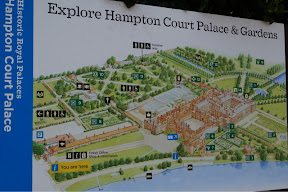
UK, London: Lessons in History at Hampton Court Palace and at the Maze


I have been planning to visit the Hampton Court Palace while in London for quite some time now. Finally, on my recent stay in London I got that opportunity.

One of the reasons, I especially wanted to explore it is that The Wilderness Garden there houses the oldest maze known in Britain. It was built for King William III and Queen Mary II in 1690. I have longed to 'get lost' in it for a bit.


I chose my visiting day according to the weather report. And accordingly, it was a really fine day in London when I boarded a train at the Waterloo station for The Hampton Court Palace. It pays off to choose a good day against a rainy one as the gardens there are such a huge part of the visitor experience. My day was also a bank holiday in UK, so there were some extra attractions, like a big picnic on the lawn that made the visit really pleasurable for me and other visitors.

Since I did not really know much about the palace beforehand, I was very pleasantly surprised to find such splendor. It really homed on me how the history can be told in so many interesting ways to make it alive even for today.


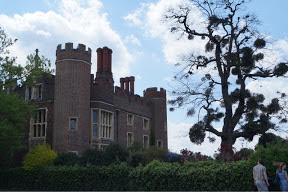
What I learned is that actually there are two palaces there; first one a Manor house developed into a palace by Thomas Wolsey, who was a powerful administrator for Henry VIII. He entertained the king there as well as a huge number of foreign dignitaries. In reality the place was a genuine hotel with kitchens servicing 1200 guests per day.


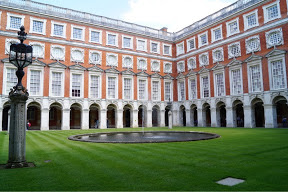
The second palace is a lovely baroque building built for Mary II and William III. They made the palace in what it is today.


And then there are the gardens from different eras kept with great dedications and research of which the Wilderness and the Maze (originally there were four of them) is the most popular.


My day at Hampton Court was all about understanding the dedication and the compassion of the people who have preserved the history for us in a way that speaks to a modern visitor. Even just seeing half of it convinces me that how we relate to history is through well written and illustrated storytelling. Learning about the young king Henry VIII certainly proves that.

What we remember from our history books is a completely different picture we get from the beautifully told story at Hampton Court Palace. There you come to understand the tragedy, the intrigue and the romance gone wrong that you otherwise might miss between Henry VIII and his first wife of more than 20 years, Catherine of Aragon.

I was walking through the rooms that depicted the young Henry VIII and came to a stop at the end. "This is a really sad room", I heard a father telling his son beside me.

On the wall there are all the names of their stillborn children (mostly boys) as well as the names of those children who died at birth. And of course Mary I and the little boy who lived for six weeks is there, also. The explanations on the chairs named Catherine, Henry and Thomas tell about the decision Henry made to divorce Catherine and how it affected the nation. Their individual stories.

This is real history lovingly brought to life for us in the modern world. I was left thinking how important it is to know those stories today. Now 20 years of their life and all those children has not gone unnoticed just because history has preferred hero stories instead of real life stories.


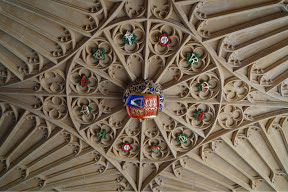
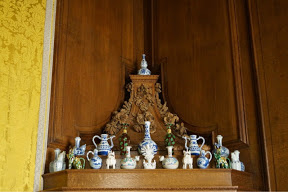
I really liked walking through the baroque palace with its wonderful ceiling art and small details, including bits and pieces of the Mary's famous porcelain collection.


There was an exhibition there about the the secrets of the State beds. Unfortunately no pictures were allowed otherwise I would have photographed the queen's bed that reminded me of the fairytale of the 'Princess and the Pea' with its layers upon layers of silk mattresses, just like in all the illustrations I have seen. What a story it turned out to be, firmly grounded in the historic reality.


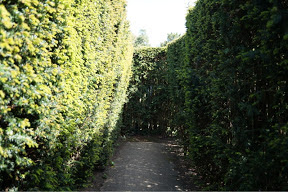
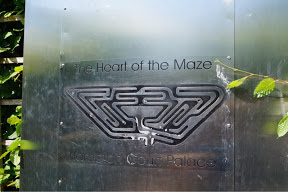
Finally, it was really fun 'getting lost' in the maze for a while, walking the old paths with lots of laughing families. And of course we found 'the heart'. It was not a very difficult task at all:


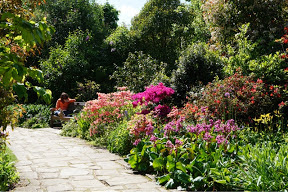
And the gardens were lovely, especially the Wilderness, that called the visitor to sit a while on a bench while taking in the atmosphere.


All in all, a day at the Hampton Court Palace was a success and I must go back since I missed the famous kitchens and the King Henry VIII's apartments and much more, I am sure.

But it was a start and a lovely day at that! I recommend it very warmly for anyone wanting a flash back to the long gone eras of royal life in Britain.
- Posted using BlogPress from my iPad

Friday, May 3, 2013

Australia, Victoria, Macedon Range: Climbing The Hanging Rock


The Macedon Range in Victoria, Australia is just a place for a compassionate traveler to visit. The possibilities are great for a day in leisure combined with adventure for the whole family. The Hanging Rock (Formerly Mount Diogenes) with the hint of mystery should be at the top of the list for anyone wanting an outing spent with a friends and acquaintances.

The Hanging Rock is a former volcano, left from a few million (6.25) years as a monument on how a special kind of stiff lava can form peculiar sites. The formation is geologically called a 'mamelon' because it is formed from dense lava that does not flow away after eruption but instead forms a hill in the place.

In 1967, a novel 'Picnic at Hanging Rock', written by Joan Lindsay was published. It is a story of a party of schoolgirls and their teacher who went to a picnic at Hanging Rock in 1900. Some of the girls and later the teacher disappeared mysteriously while there. The case was never solved in anyone's satisfaction.

This story inspired a film:


'Picnic at Hanging Rock', in 1995, directed by Peter Weir. It was one of the first Australian films that truly created an international following.

The Hanging Rock has also inspired plenty of artists:


'At The Hanging Rock' by William Ford, 1885. (Picture from Wikipedia) is one of the earliest ones on display at the Victorian National Gallery.

I went looking for that particular place it was painted at and may just have found it here:


The Hanging Rock is quite a challenge to climb. I recommend sturdy shoes and great spirits.

There is a large picnic ground at the bottom, including a restaurant and a discovery centre. We found it really inspirational.

There are two ways up the rock, the stairs and the well made path. It should be easy to climb, being only 105m above the plain, even for the faint hearted, providing some rests can be had. Though, caution is recommended as always.


We found the rock really majestical and fun. The climb was vigorous activity and the discovery centre and the shop a real treat.


We inspected several cracks just to make sure that all has been done to solve the mystery of the Hanging Rock by now. Nothing suspicious was found.

At the end of the day, we had some ice-cream, the really fabulous kind, paid our $10 fee for the car to get out of the gate and left with great satisfaction.

A well recommended and enjoyable day for everyone.
- Posted using BlogPress from my iPad

Saturday, December 15, 2012

USA, South Carolina, Greenville: A Very Special Kind of Scavenger Hunt


Be charmed by a visit to Greenville in South Carolina in the USA. This city has a special treat to offer for those on the hunt for fun activities for the whole family.

In 2000, Jimmy Ryan, a high school senior from the local area wanted to do something special for his community by designing and developing the famous Mice on Main Scavenger Hunt for little mouse sculptures inspired by the popular Children's book Goodnight Moon. He raised funds and worked with a sculptor Zan Wells who created the little mice in bronze. They can be found hidden along the Main St of Greenville where thousands of people come to find them.


According to what I was told, the city has done a lot in beautifying the Main Street and the local Falls Park. The partnership of Jimmy Ryan and Zan Wells now also includes a writer Linda Kelly who wrote a book about how the Mice on Main found their 'freedom' and 'sparkle' prompted by her grand daughter who wanted to know about how the mice found their places on the street.

The combined efforts of the city, the creator, the artists and the writer have certainly paid off with the popularity of the park and the hunt that fills the city with tourists on a nice autumn day. It can be said that the realization of one brilliant idea has really created value for the community of Greenville. We certainly enjoyed our day there.


There is lots of information to be found by just googling Mice on Main or the name of artists. They have created additional goodwill with little mice sculptures and special t-shirts. The proceeds from the book and the shirts go to a charity it the area.

So, it can be said that Greenville presents its compassion and friendliness for the community and the world in practice with a very charming front. I look forwards to visiting there again and recommend you to do the same.

- Posted using BlogPress from my iPad

Saturday, November 24, 2012

USA, Indianapolis, Indiana: Christmas Cheer at Eiteljorg Museum of American Indians and Western Art


If you ever think of visiting Indianapolis for family fun, you could choose the time when the Eiteljorg Museum of American Indians and Western Art is at its best. That would be in November and December, every year.

For the past three years, during the Christmas season, the museum has exhibited an ever expanding Model Trains and the American West section where the whole family can enjoy the joy of seeing many of the famous landmarks of the American West in 1:32 and 1:28 scale. What a fun thing to do!


The attendant, I interviewed about it said that the aim of the exhibition is to get families to the museum and also at the same time introduce them to the magnificent collection of Western Art exhibited at the Museum otherwise.

I can surely appreciate that it truly is magnificent. The best I have ever seen. It draws you and gives you insights to the way the American West was occupied by the white people. The art is absolutely fabulous.

I saw a painting which made me comment to the friend that I recognise the style. It is the Russian St Petersburg School of Art style which I have seen in my own country.

It tuned out that the painter was Russian. How marvelous was that. In fact there were two Russian style painters depicting the Western life. It soon became clear that it were the painters who were the true anthropologists of the West, preserving the lost Indian culture to the future generation.


The Christmas exhibition brings people from all over to the museum. Is makes around 50% of the total visitor numbers to the museum during the whole year.

For the compassionate world traveler, the museum is a gem. It reminds us of the times gone by and the commitment of some truly talented people who saw the future of the West and wanted to gift the pictures of the life in the past to the future generations.

Visiting the Museum makes you sad but also makes your heart sing to see the quality of care that has gone into presenting the artifacts and the art to the modern audience.

I warmly recommend the experience to everyone.

- Posted using BlogPress from my iPad

Tuesday, May 8, 2012

Australia, Queensland, Sunshine Coast at Bli Bli; The Finnish Memorial Park


On the Finland Rd at Bli Bli, at the Sunshine Coast, there is a park that would interest the Finnish immigrant population to Australia, if not all the immigrants to Australia. It is the Finnish Memorial Park, created by the Finnish cane cutter families that lived there during the times when cane was still cut at the Sunshine Coast.

It was about 17-years ago that I had last visited this place. Then it was just cane fields, but the place for the park had been selected and the organisers of the planned park were just getting to ordering the memorial sculpture. After much discussion they settled in inviting Martti Väänänen, a sculpturer from Kiiminki in Finland to create the memorial. The park itself was opened in 1997. At the same time it was also donated to the Council for upkeep.

The Finland Rd as such is a long and lumpy ride amongst the last cane fields at Sunshine Coast. Not much of them is left as the new suburbs are born across the coastline. However, it is a delight to suddenly end up in a small, well tendered park that makes one remember those people who came to Australia on ships, after spending weeks on the oceans, and months on the migration centers in the south and ending up in Queensland on the cane fields.
The Migration Museum at Peräseinäjoki in Finland, previously presented on this blog, carries matching information about the emigration of the Finnish people to around the world. I am hearing that more than million Finnish people live permanently abroad.

One of the highlights of the Finnish Migration Museum is the cane cutters cottage that was actually dissembled in Ingham, Queensland and sent to the Museum at Peräseinäjoki, where it was reassembled in a totally new surroundings to the delight of many people interested in the migration history of the people of the area.

The Finnish Memorial Park at Bli Bli carries on the delightful tradition of people building spaces for themselves where they can comfortably meet and have a picnic in memory of the times gone by. I, for one, can very well see this park as a functional meeting place for a family gathering, even a wedding as there is a kind of Finnish style pavilion included in the park just inviting dancing.

When choosing a place where people could meet at Sunshine Coast for a celebration, the Finnish Memorial Park is a good pick. It is well kept, secluded and spacious. See you there sometime on your travels.

- Posted using BlogPress from my iPad